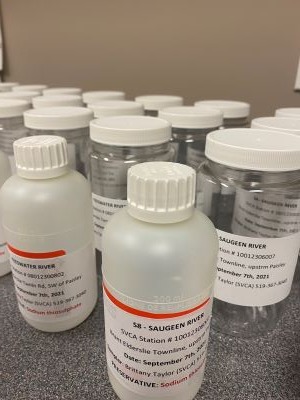
Grey Bruce Public Health and Saugeen Valley Conservation Authority (SVCA) engage in water testing with divergent objectives and scopes in mind. The Public Health Unit primarily tests municipal and small drinking water systems, public pools, spas, and 13 public beaches, focusing on detecting bacterial contamination such as E. Coli and blue-green algae for safeguarding public health.
https://www.publichealthgreybruce.on.ca/Your-Environment/Safe-Water/Recreational-Water
The Public Health Unit does facilitate free bacterial testing for private drinking water systems; however, the onus of collecting and submitting samples under this program falls on the individual landowners. The sole parameter in this program is E.Coli.
SVCA is not a public health agency; its core mission revolves around gaining insights into the aquatic ecosystem health in the Saugeen River watershed. This focus is unique within the watershed, as no other agencies, including municipalities and Grey Bruce Public Health, undertake sampling with the intention of assessing aquatic ecosystem health. SVCA’s distinctive approach and the parameters tested can also provide indications of potential public health concerns, particularly for recreational users such as anglers, canoers, and tubers, by detecting elevated levels of contaminants like E. Coli in the Saugeen River.
SVCA’s Water Quality Program encompasses testing for several key parameters not assessed by the Public Health Unit, each offering distinct insights into the health of our watershed:
- Phosphorus: Originating from both natural sources and human activities like agriculture and industry, high concentrations can lead to excess algae growth, oxygen depletion, and harm to aquatic life.
- Nitrogen: While naturally occurring, additional sources include fertilizers, livestock manure, and septic systems, potentially impacting water quality.
- Chloride: Deriving primarily from road salt application and industrial production, high concentrations can be toxic to aquatic life, with studies indicating increasing trends in surface and groundwater chloride levels.
- Total Suspended Solids: Occurring naturally and increased by human activities, high concentrations can reduce sunlight penetration, affecting aquatic plants and animals, and impact fish populations by altering habitats and food sources.
- Benthic Macroinvertebrates: These organisms are indicators of water quality, with different species varying in pollution sensitivity. Sampling can detect contamination not identifiable through routine water quality tests, including short-duration contamination from incidents like chemical spills.